FemiPro vs FemiCore: Which Bladder Support Supplement Wins in 2026?
Disclosure: WhereToBuyHub may earn a commission if you buy through links on this page, at no extra cost to you. Full disclosure policy.
By the WhereToBuyHub Editorial Team. Last updated October 30, 2026. Prices and refund terms were checked on both official pages on October 30, 2026.
If you are comparing FemiPro vs FemiCore, the honest answer is that the two offers are closer than most articles admit. We read both official pages, their refund and shipping policies and their reference lists, and compared them line by line. This FemiPro vs FemiCore comparison shows what is the same, what is different and how to decide.
FemiPro
- Ingredients: 5 listed, with an unnamed probiotic blend
- Price: from $49 per bottle (6 bottles)
- Refund: 60 days from delivery
- Retailer: DigiStore24
FemiCore
- Ingredients: 9 listed, with 5 named probiotic strains
- Price: from $49 per bottle (6 bottles)
- Refund: 60 days from delivery
- Retailer: ClickBank
FemiPro vs FemiCore: Side-by-Side Comparison
| FemiPro | FemiCore | |
|---|---|---|
| Mechanism claimed | Supports urinary microbiome balance | Supports urinary microbiome balance |
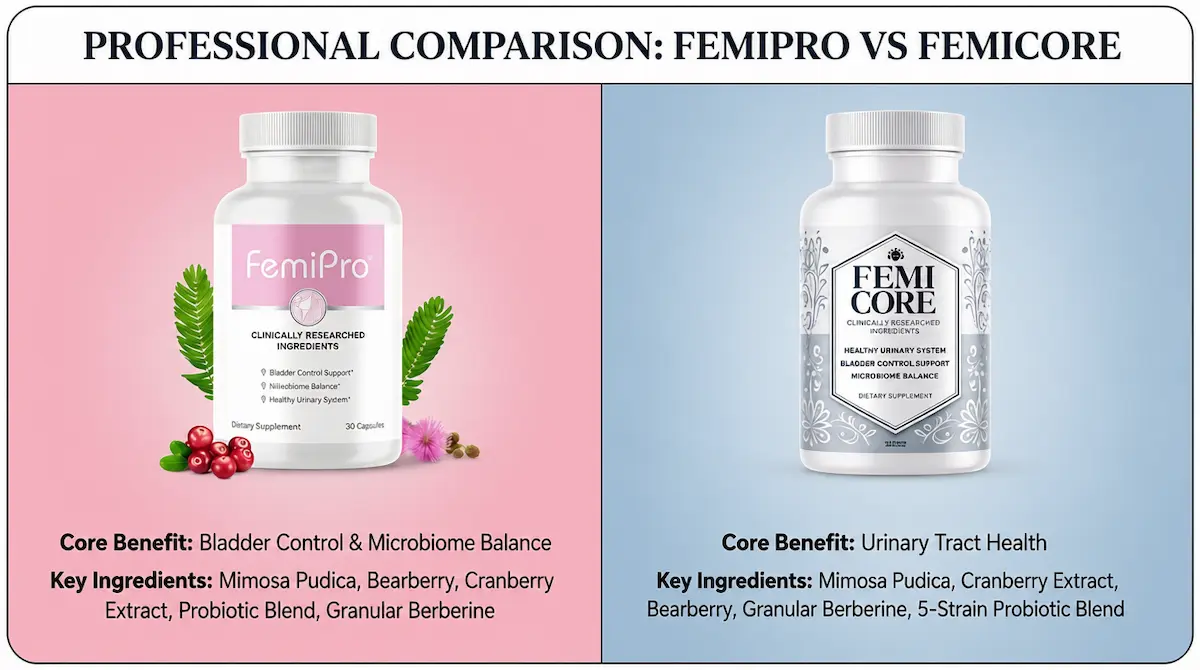
| Ingredients listed | Mimosa Pudica, Bearberry, Cranberry Extract, Probiotic Blend, Granular Berberine | Mimosa Pudica, Bearberry, Cranberry Extract, Granular Berberine, plus 5 named Lactobacillus strains |
| Amounts per ingredient | Not informed (proprietary blend) | Not informed (proprietary blend) |
| How to take | 1 capsule a day with plenty of water | 1 capsule every morning with a big glass of water |
| Price per bottle | $79 (2 bottles), $69 (3), $49 (6) | $79 (2 bottles), $69 (3), $49 (6) |
| Shipping (US) | $9.99 on the 2-bottle pack, free on larger packs | $9.99 on the 2-bottle pack, free on larger packs |
| Refund | 60 days from delivery, return shipping paid by you | 60 days from delivery, return shipping paid by you |
| Retailer | DigiStore24 | ClickBank |
| Bonus guides (6 bottles) | 3 in one place, 2 in another on the same page | 3 |
Prices and policies in this FemiPro vs FemiCore comparison were checked on October 30, 2026 and can change. Confirm them on the official pages before buying.
FemiPro vs FemiCore: What the Official Pages Claim
Many articles, including an earlier version of this one, said FemiCore works on pelvic floor muscles while FemiPro works on the microbiome. The official pages do not support that split. Both say their formula supports a healthy balance of bacteria in the urinary microbiome and helps reduce involuntary leaks. FemiCore’s page also blames tampon-related “toxic dioxins” for microbiome imbalance, a marketing narrative we could not verify, while FemiPro’s page does not make that claim in its text.
FemiPro vs FemiCore: Ingredients Compared
Four ingredients appear in both: Mimosa Pudica, Bearberry, Cranberry Extract and Granular Berberine. The difference is the probiotic part. FemiCore lists five Lactobacillus strains by name (crispatus, acidophilus, plantarum, gasseri and casei). FemiPro lists a “Probiotic Blend” and does not say which strains it contains. Neither page gives the amount of any ingredient, so we cannot compare doses.
FemiPro vs FemiCore: Price, Shipping and Refund
| Package | Price per bottle | Total | Shipping (US) |
|---|---|---|---|
| 2 bottles (60-day supply) | $79 | $158 | $9.99 |
| 3 bottles: buy 2, get 1 free (90-day supply) | $69 | $207 | Free |
| 6 bottles: buy 3, get 3 free (180-day supply) | $49 | $294 | Free |
Both pages list the same shipping table: free in the United States with 5 to 7 working days, and $15.95 to Canada, the UK and Ireland, and Australia and New Zealand with 10 to 15 working days. The refund text is the same on both: you have 60 days from delivery, you email support with “Refund Request” in the subject, and you send back all bottles, empty or not, with the packing slip. You pay the return shipping, and the return address is the same. The policy also advises using the product for at least 3 months before judging it, which is longer than the refund window.
FemiPro vs FemiCore: What the Research Shows
Both pages share the same list of scientific references. We read the titles and journals but did not open every paper. Several are cross-sectional studies comparing the urinary microbiome of women with and without incontinence, such as Price and colleagues in the American Journal of Obstetrics and Gynecology (2020). That kind of study shows an association, not that a supplement works. The bearberry reference is the protocol of a planned trial (BMJ Open, 2022), the Mimosa pudica reference is a laboratory study and the berberine reference is research in diabetic rats. No reference tests FemiPro or FemiCore.
FemiPro vs FemiCore: How to Take Each
Both are one capsule a day. FemiCore’s page says to take it every morning with a big glass of water, and FemiPro’s says to take it with plenty of water and gives no time of day. A bottle of either is listed as a 30-day supply. Follow the directions on your own bottle, and use the same time each day so you can judge how you feel over several weeks.
FemiPro vs FemiCore: Safety
Because the two share bearberry and berberine, the same cautions apply to both. Bearberry leaf is generally described for short-term use; the European Medicines Agency’s herbal monograph lists kidney disorders as a contraindication and advises avoiding it in pregnancy. Berberine can affect how some medicines are processed. Neither page states ingredient amounts, and both suggest using the product for months. Ask your doctor or pharmacist before starting, and see a doctor for persistent bladder symptoms. The NIH’s overview of bladder control problems explains common causes.
Who Should Skip Both
Skip both, and talk to a doctor first, if you are pregnant or nursing, have kidney disease, take prescription medication, or have symptoms such as burning with urination, fever or blood in the urine. Bearberry, which both contain, is generally avoided in pregnancy and kidney disorders. If you have a weakened immune system, ask a doctor before using probiotic supplements, since both include probiotics.
How We Compared FemiPro vs FemiCore
For this FemiPro vs FemiCore comparison we read both sales pages, their refund and shipping policies and their reference lists, and put the facts in the same table. We did not buy or test either product and we did not use customer testimonials, because we cannot verify them. Where a page does not say something, such as the amount of each ingredient, we write “not informed” rather than guess. Both pages also show review counts and a “96% order six bottles” figure that we could not trace to a source, so we left them out of the comparison.
FemiPro vs FemiCore: Which One Should You Choose?
Because the offers are so similar, the choice is less about symptoms than about what you want to know before you buy:
- Choose FemiCore if you want to know which probiotic strains are in the capsule, since it names them and FemiPro does not.
- Choose FemiPro if you prefer a shorter ingredient list, or if you would rather order through DigiStore24 than ClickBank. The herbs are the same in both.
- Do not buy both for the same purpose. They share ingredients, and no research supports combining them.
- See a doctor first if your leaks are new, getting worse, or come with pain, fever or blood in the urine. A supplement is not a diagnosis.
Read our full individual reviews: FemiPro review and FemiCore review. For recurring discomfort, see recurring UTIs and FemiPro and 5 ways to balance your vaginal microbiome naturally.
Frequently Asked Questions
1. Is FemiPro or FemiCore better?
On the evidence we could check, neither is clearly better. The two official pages use the same price structure, refund text and reference list, and neither has a published trial of the finished capsule. The main differences are that FemiCore names its five probiotic strains and lists nine ingredients, while FemiPro lists five ingredients and an unnamed probiotic blend.
2. Is FemiCore for muscle leaks and FemiPro for microbiome balance?
No. Older articles, including an earlier version of this one, described them that way, but both official pages say the product works by supporting urinary microbiome balance. Neither page claims a pelvic floor muscle mechanism.
3. Can I take FemiPro and FemiCore together?
We found no research on combining them. They share four of the same ingredients, including bearberry and berberine, so taking both could double those, and neither page states the amounts. Talk to your doctor or pharmacist before combining supplements.
4. Which one has the better refund policy?
They are the same: 60 days from delivery, email support first, return all bottles at your own cost to the same address, and the policy advises using the product for at least 3 months before judging it. Only the retailer differs, ClickBank for FemiCore and DigiStore24 for FemiPro.
5. Are FemiPro and FemiCore made by the same company?
We cannot confirm who makes either one, because neither page names the maker. They do share refund text, a return address, a shipping table and a reference list, which suggests a common source, but that is our observation and not a statement from the sellers.
Sources
- FemiPro and FemiCore official websites: sales pages, Refund and Shipping Policies and reference lists, checked October 30, 2026.
- Price TK, Lin H, Gao X, et al. Bladder bacterial diversity differs in continent and incontinent women: a cross-sectional study. American Journal of Obstetrics and Gynecology. 2020 (as listed on the official pages).
- Tóth B, et al. Bearberry in the treatment of acute uncomplicated cystitis (BRUMI): protocol of a multicentre, randomised double-blind clinical trial. BMJ Open. 2022 (as listed on the official pages).
- European Medicines Agency. Community herbal monograph on Arctostaphylos uva-ursi folium.
- NIDDK. Bladder control problems: symptoms and causes.
These statements have not been evaluated by the Food and Drug Administration. FemiPro and FemiCore are not intended to diagnose, treat, cure or prevent any disease. This page is for information only and is not medical advice. Talk to a qualified healthcare professional before starting any supplement.